 Pennsylvania: In the grand scheme of things, it can seem like progress in science
and medicine moves pretty slow. For example, we still aren’t sure what
causes premature birth, or why racial disparities exist in certain
conditions. And, for all intents and purposes, Alzheimer’s is still a
big black box. But in reality, when you put science and medicine under
the microscope, you find that a single year can bring big, meaningful
gains and exciting advances. So, as we welcome a brand new year, let’s pause to reflect on some of
Penn Medicine’s biggest newsmakers from the last 12 months.
Pennsylvania: In the grand scheme of things, it can seem like progress in science
and medicine moves pretty slow. For example, we still aren’t sure what
causes premature birth, or why racial disparities exist in certain
conditions. And, for all intents and purposes, Alzheimer’s is still a
big black box. But in reality, when you put science and medicine under
the microscope, you find that a single year can bring big, meaningful
gains and exciting advances. So, as we welcome a brand new year, let’s pause to reflect on some of
Penn Medicine’s biggest newsmakers from the last 12 months.
Showing posts with label transplantation. Show all posts
Showing posts with label transplantation. Show all posts
Wednesday, January 4, 2017
2016's Biggest Medical Science Revolutions
Pennsylvania: In the grand scheme of things, it can seem like progress in science
and medicine moves pretty slow. For example, we still aren’t sure what
causes premature birth, or why racial disparities exist in certain
conditions. And, for all intents and purposes, Alzheimer’s is still a
big black box. But in reality, when you put science and medicine under
the microscope, you find that a single year can bring big, meaningful
gains and exciting advances. So, as we welcome a brand new year, let’s pause to reflect on some of
Penn Medicine’s biggest newsmakers from the last 12 months.Saturday, November 12, 2016
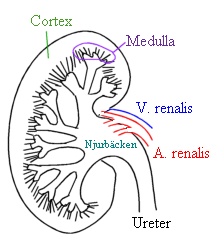
Low-potassium diet increases risk of losing donor kidney
Tuesday, June 23, 2015
Will head transplants create an entirely new person?

Wednesday, June 17, 2015
Researchers discover molecule that accelerates tissue regeneration after bone marrow transplants

Tissue ‘scaffold’ technology could help rebuild large organs

Bristol: Scientists have
developed a new tissue ‘scaffold’ technology that could one day enable
the engineering of large organs. Research led by the Universities of
Bristol and Liverpool has shown that it is possible to combine cells
with a special scaffold to produce living tissue in the laboratory. It
is hoped this can then be implanted into patients as a way of replacing
diseased parts of the body. Until
now, the approach has generally been limited to growing small pieces of
tissue, as larger dimensions reduce the oxygen supply to the cells in
the centre.
Sunday, June 14, 2015
Teams from Houston Methodist Hospital and The University of Texas perform first multi-organ transplant that includes skull and scalp

Monday, June 8, 2015
Sixth kidney transplantation for a woman in France with help of a new drug
.jpg/120px-thumbnail.jpg)
Thursday, June 4, 2015
Building replacement kidneys in the lab

Wednesday, June 3, 2015
Don’t blame families for low organ donation rates, fix the system

Wednesday, April 8, 2015
Study Suggests Acute Injured Kidneys can be considered for Transplant

Kidneys can result in acute injury when the organ ceases to function, generally caused by heavy blood loss, severe infection, extreme dehydration and some medications. At the same time, according to Dr. Heilman, “The kidney has a remarkable ability to regenerate parts of the organ that weren’t working.”
Tuesday, April 7, 2015
Purging a virus from organ transplants

Tuesday, March 31, 2015
Cell transplant therapy can help people with diabetes
Edinburgh: People with Type 1 diabetes are being helped by a transplant therapy that uses cells from the pancreas, a study shows. Patients who have received the cells from donor organs have shown an improved quality of life, University researchers say.
The technique aims to combat hypoglycaemia - a drop in blood
sugar triggered in patients on insulin treatment, which can prove fatal.Monday, March 16, 2015
New hope for kidney disease
Monash: Researchers have made a discovery that could see patients with kidney
disease no longer having to resort to dialysis or kidney transplants.
Friday, March 13, 2015
Even injured kidneys can be used for transplants
Yale: Kidneys from deceased donors that have acute injuries are frequently
discarded instead of being used for transplant. However, a Yale-led
study finds that such kidneys may be more viable than previously
thought, and should be considered to meet the growing demand for organ
transplants.
Wednesday, March 11, 2015
Immunological successes drive transplants forward
Karolinska: Recent years have seen many breakthroughs within
immunology and the effects of these are now being seen in clinics. At a
conference at the Swedish medical university Karolinska Institutet we
will hear about how this new knowledge is being used to understand
diabetes and treat cancer. New possibilities are also opening up for
sorts of transplants – not just of internal organs but also of arms.
Saturday, March 7, 2015
Baylor-led study examines lung transplantation outcomes since implementation of need-based organ allocation system
Baylor: A study led by researchers at Baylor College of Medicine has revealed
that since the implementation in 2005 of a medical need-based
allocation system for donor lungs, double-lung transplantation has been
associated with better graft survival than single-lung transplantation
in patients with idiopathic pulmonary fibrosis (IPF). However, there has
been no survival difference between double- and single-lung transplant
recipients in patients with chronic obstructive pulmonary disease, or
COPD.
Friday, February 20, 2015
Gentler treatment effective for many with graft-vs.-host disease
Hutchinson Center. US: A new study finds halving standard steroid dose treats most acute Graft Versus Host Disease just as well; could limit dangerous side effects.
Tuesday, February 17, 2015
Transplant patients have high rate of cancer death
University od Adelaide. Australia: Researchers at the University of Adelaide are working to better
understand how patients who receive life-saving organ transplants can be
spared from dying of cancer many years later. Transplant
patients are 3-5 times more likely to develop cancer than the general
population. For example, one third of Australian kidney transplant
patients will eventually die of cancer many years after their surgery –
and a third of these deaths are due to skin cancer.
Growing number of donor hearts rejected while need for transplants rises, study finds
Stanford University. US: A new study has found that improving scientific guidelines to determine
whether a donor heart is acceptable for transplant will help save the
lives of patients with deadly heart disease.
Wednesday, February 11, 2015
Growing number of donor hearts rejected while need for transplants rises, study finds
Stanford University. US: A new study has found that improving scientific guidelines to determine
whether a donor heart is acceptable for transplant will help save the
lives of patients with deadly heart disease.
Subscribe to:
Comments (Atom)