Showing posts with label HIV. Show all posts

Saturday, April 22, 2017

Teaching happiness to men with HIV boosts their health

NorthWestern: When individuals recently diagnosed with HIV were coached to practice skills to help them experience positive emotions, the result was less HIV in their blood and lower antidepressant use, reports a new Northwestern Medicine study. “Even in the midst of this stressful experience of testing positive for HIV, coaching people to feel happy, calm and satisfied — what we call positive affect — appears to influence important health outcomes,” said lead author Judith Moskowitz, professor of medical social sciences and director of research at the Osher Center for Integrative Medicine at Northwestern University Feinberg School of Medicine.

Tuesday, April 11, 2017

Millions of New HIV Infections Can be Averted, Yale Model Predicts

Yale: Though there have been extraordinary advances in HIV/AIDS treatment in the past several years, the disease remains a serious health concern worldwide. Promising developments in HIV vaccines are occurring all the time, but their potential long-term impact is still unknown. Using a novel mathematical model, a team at the Yale School of Public Health predicts that vaccines used in concert with other interventions have the potential to avert several million cases of the disease in the coming years.

Sunday, March 5, 2017

Hope for HIV control in southern Africa: The continued quest for a vaccine

Plos: It is estimated that almost 2 million new HIV infections occurred in the world in 2015 [1]. Southern and eastern Africa, with 6.2% of the world’s population, bear a disparate half of the world’s HIV infection burden and would benefit greatly from inexpensive innovations aimed at curtailing the epidemic. A recent modelling study showed that introducing a partially (30%) effective vaccine for HIV in resource-limited settings such as southern Africa would result in an estimated 67% reduction in HIV incidence compared to a non-vaccine scenario [2]. As sub-Saharan Africa has the highest incidence of HIV infection in the world, that the introduction of a vaccine with only partial efficacy could have such a dramatic effect, despite the existing availability of comprehensive prevention methods, is strongly persuasive for the pursuit of a vaccine-based approach [3].

Friday, February 24, 2017

Understanding how HIV evades the immune system

Melbourne: Monash University and Cardiff University (UK) researchers have come a step further in understanding how the human immunodeficiency virus (HIV) evades the immune system. Declared a pandemic in 1987 by the World Health Organization, HIV infection has been responsible for 39 million deaths over the last 30 years. It remains one of the world’s most significant public health challenges and thus a greater understanding of how HIV functions is urgently needed so that researchers can design better therapies to target this devastating pathogen.

Friday, December 23, 2016

Scientists find new way to reverse immune suppression caused by HIV

North Carolina: Combined anti-retroviral therapy (cART) has been a crucial clinical tool in the battle against HIV for nearly two decades. But for some HIV-positive individuals, despite complete or near-complete suppression HIV replication by cART, both chronic inflammation and immune dysfunction persist, a condition that can slow T-cell recovery and accelerate the progression of HIV. New research from the UNC School of Medicine, published today in the Journal of Clinical Investigation, suggests that interfering with persistent type I interferon (IFN-I) signaling – a cellular protein pathway linked to chronic immune activation – can promote better immune recovery and viral suppression when used in combination with cART in animals.

The Microbiome and Risk for HIV

Columbia: Mailman School Epidemiology Professor Salim Abdool Karim had a question: why were young women in Africa at higher risk of acquiring HIV infection than young men? Studies conducted by the Mailman School–affiliated Centre for the AIDS Program of Research in South Africa (CAPRISA) showed that women aged 15 to 24 in that country are upward of four times more likely to be infected with HIV than their male counterparts. Analyzing data from a clinical trial of a vaginal microbicide, Karim, director of CAPRISA, and his immunology team found that vaginal inflammation accurately predicted which women would get infected with HIV. The finding raised another important question: what was behind the inflammation that was putting women at risk for HIV?

Wednesday, November 30, 2016

Why over 45s are at risk of sexually transmitted infections – new findings

TheConversation: One consequence of our ageing population is that people are now sexually active later in life. Combined with a high rate of older adults divorcing and changing partners, this has created a conducive environment for sexually transmitted infections (STIs) among those in middle age and beyond. While the under 25s and gay men remain most at risk from STIs, heterosexual adults over 45 have recently seen increases in HIV, gonorrhoea, herpes, syphilis, chlamydia and genital warts. In England, rates for chlamydia, the commonest STI, rose 63% among 45-64s between 2011 and 2015 while falling for 15-24s. Yet this is an area of public health that has so far been ignored.

Wednesday, November 16, 2016

HIV test performed on USB stick

London: Imperial College London and DNA Electronics, uses a drop of blood to detect HIV, and then creates an electrical signal that can be read by a computer, laptop or handheld device. The disposable test could be used for HIV patients to monitor their own treatment. Furthermore, the technology could enable patients with HIV to be managed more effectively in remote locations. New research, published in the journal Scientific Reports, shows the device is not only very accurate, but can produce a result in under 30 minutes.

Wednesday, November 9, 2016

The how, what and why of the latest HIV vaccine trial

TheConversation: As the global quest for an HIV vaccine continues, Linda-Gail Bekker explains the significance of the latest large-scale trial underway in South Africa.
What’s the significance of the trial for the global fight against HIV?
The world needs an HIV vaccine. Our prevention toolbox is better than it has ever been. But there is increasing recognition that the world needs to scale up primary HIV prevention.
Effective vaccination is the poster child for prevention – it is the thing we are missing. If we can get that we can talk about eliminating HIV across the world.

Test for two: Self-testing as a couple improves HIV test rates

Scimex: Providing pregnant and postpartum women in sub-Saharan Africa with multiple HIV self-tests can make it more likely their male partners will be tested for HIV compared to a standard approach of distributing invitation cards for clinic-based testing, according to a randomized trial published in PLOS Medicine by Harsha Thirumurthy of the University of North Carolina at Chapel Hill, USA, and colleagues.

Tuesday, November 8, 2016

School-based interventions for preventing HIV, sexually transmitted infections, and pregnancy in adolescents

Cochrane researchers conducted a review of the effects of school-based interventions for reducing HIV, sexually transmitted infections (STIs), and pregnancy in adolescents. After searching for relevant trials up to 7 April 2016, they included eight trials that had enrolled 55,157 adolescents. Sexually active adolescents, particularly young women, are at high risk in many countries of contracting HIV and other STIs. Early unintended pregnancy can also have a detrimental impact on young people's lives.
The school environment plays an important role in the development of children and young people, and curriculum-based sexuality education programmes have become popular in many regions of the world. While there is some evidence that these programmes improve knowledge and reduce self-reported risk taking, this review evaluated whether they have any impact on the number of young people that contracted STIs or on the number of adolescent pregnancies.

Thursday, November 3, 2016

HIV’s Patient Zero exonerated

Nature: A study clarifies when HIV entered the United States and dispels the myth that one man instigated the AIDS epidemic in North America. In 1982, sociologist William Darrow and his colleagues at the US Centers for Disease Control and Prevention (CDC) travelled from Georgia to California to investigate an explosion in cases of Kaposi’s sarcoma, a type of skin cancer, among gay men. Darrow suspected that the cancer-causing agent — later shown to be a complication of HIV infection — was sexually transmitted, but lacked proof. His breakthrough came one day in April when three men from three different counties told Darrow that they had had sex with the same person: a French Canadian airline steward named Gaétan Dugas.

Wednesday, November 2, 2016

Implantable nanochannel device delivers HIV prevention drug
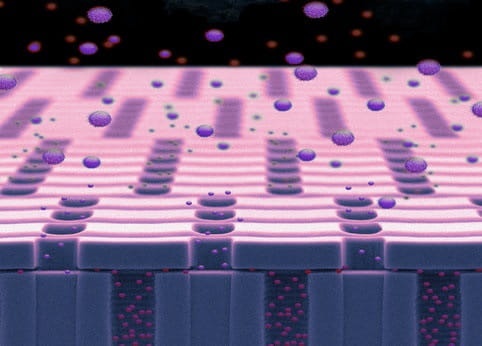
Houston: A Houston Methodist research team received a nearly $4 million grant to test a transcutaneously refillable implant that administers pre-exposure prophylaxis drugs to subjects at risk of HIV-exposure. The National Institute of Allergy and Infectious Diseases (NIAID) awarded Alessandro Grattoni, Ph.D., the multi-million dollar grant over five years to enhance the nanochannel delivery system (nDS), which provides sustained and constant release of drugs without the use of pumps, valves or a power supply.

Tuesday, June 16, 2015

HIV Paradox: New clue shows how some fight infection without drugs
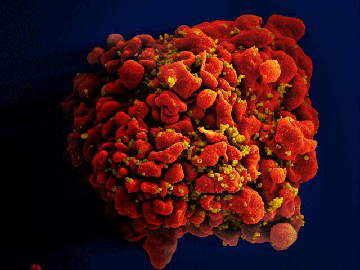
Harvard: Investigators from Harvard Medical School, Massachusetts General Hospital, and the Ragon Institute of MGH, MIT and Harvard have added another piece to the puzzle of how a small group of individuals known as elite controllers are able to control HIV infection without drug treatment. In their paper published in the journal PLOS Pathogens, the research team reports finding that dendritic cells of elite controllers are better able to detect the presence of HIV—paradoxically through a greater susceptibility to HIV infection—which enables them to stimulate the generation of T cells specifically targeting the virus.

Thursday, June 11, 2015

Europe's most homophobic countries may be paving the way for a rise in HIV cases

London School of Hygiene: Europe’s most homophobic countries may be paving the way for a rise in HIV cases among gay and bisexual men, according to new research published in the journal AIDS. An international team of researchers from Europe and the US looked at HIV-related service use, need and behaviours among 175,000 gay or bisexual men living in 38 European countries with differing levels of national homophobia. They found that men in homophobic countries had fewer sexual partners and were less likely to be diagnosed with HIV. However, they also found those men knew less about HIV, were less likely to use condoms and are at greater potential risk of getting HIV when they do have sex.

Antibody Response Linked To Lower Mother-to-Child HIV Transmission

Duke: How most babies are protected from acquiring HIV from their infected mothers has been a matter of scientific controversy. Now researchers at Duke Medicine provide new data identifying an antibody response that had long been discounted as inadequate to confer protection. Mother-to-child transmissions account for about 250,000 HIV infections per year worldwide, despite greatly expanded access to antiretroviral drug regimens that can interrupt transmission into low-resource settings. Ongoing problems with access to the drugs, late initiation of the drug regimens during pregnancy, and acute maternal infection during pregnancy and breastfeeding all contribute to the ongoing infant transmission. 

Saturday, May 30, 2015

Interventions for improving employment outcomes for workers with HIV

Cochrane: For people living with HIV(HIV+), losing their job can make it even harder to cope with the illness. This review aimed to assess how we can prevent HIV+ people from losing their jobs or help them return to work. There are three approaches to achieve these aims. The first one is to use drugs, meaning antiretroviral therapy, to keep the disease and its symptoms from getting worse. The second is to make changes to work tasks or the work environment. The third is to offer psychological support to help the HIV+ person cope better with their condition, especially at work.

Thursday, May 28, 2015

Treating HIV early leads to better health and less transmission

Early_hiv_treatment_is_a_win-win_strategy_david_smart_shutterstock.jpgUNSW: Starting HIV treatment early, before immune damage occurs, brings real clinical benefits. But taking antiretrovirals is a daily, life-long commitment and people need support to make the right choices, writes Bridget Haire. The START (Strategic Timing of antiRetroviral Treatment) clinical trial was recently terminated ahead of schedule because the trial results provided conclusive evidence of the extra benefits of beginning antiretroviral therapy early.

World-first study finds early HIV treatment halves risk of serious complications

UNSW: An international study led by UNSW’s Kirby Institute has shown immediate treatment for people diagnosed with HIV can halve their risk of HIV-related serious disease or death. The study was terminated ahead of schedule after interim results provided conclusive evidence that immediate treatment with antiretroviral therapy (ART) is clinically superior compared to deferred treatment. The study findings have global implications for the treatment of people living with the virus and will influence global treatment regimens. Approximately 30 million people worldwide are living with HIV with only a third of this group receiving treatment.

Friday, May 22, 2015

HIV and the Microbiome
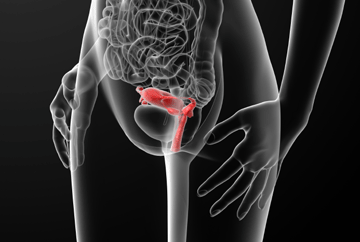
Harvard: A team led by Harvard Medical School researchers from Massachusetts General Hospital and the Ragon Institute of MGH, MIT and Harvard has found that the most common bacterial community in the genital tract among healthy South African women is not only significantly different from that of women in developed countries, but also leads to elevated levels of inflammatory proteins. In a paper published in Immunity, the investigators described finding potential mechanisms by which particular bacterial species induce inflammation and showed that the presence of those species and of elevated levels of inflammatory proteins could increase the risk of HIV infection.