Radboud: It may be difficult for addicted individuals to learn when
they can expect a reward. This learning problem could perhaps explain
why they are more prone to addiction and find it difficult to kick the
habit. Researchers at Radboud university medical center and Radboud
University reached this conclusion on the basis of an extensive
meta-analysis of the brain imaging literature. Their findings
were published in JAMA Psychiatry on 1 February. People with an addiction process rewards in
their brain differently from people who are not addicted. However,
whether this is associated with “too much” or “too little” brain
activity is an open question. Indeed, past research has produced
conflicting findings.
Showing posts with label psychiatry. Show all posts
Showing posts with label psychiatry. Show all posts
Wednesday, February 22, 2017
Friday, December 16, 2016
How do trauma symptoms combine to create chronic PTSD?

Monday, November 28, 2016
Smoking harms not just your physical health, but your mental health too
 TheConversation: A middle-aged cigarette smoker who has smoked for decades is two
to three times more likely to die early than someone similar who has
never smoked. Tobacco smoking is well known to be a major risk factor
for various cancers, lung and cardiovascular problems, and is also
linked to other health problems, such as complications in pregnancy, low
sperm count in men, oral problems, and increased likelihood of
cataracts.
TheConversation: A middle-aged cigarette smoker who has smoked for decades is two
to three times more likely to die early than someone similar who has
never smoked. Tobacco smoking is well known to be a major risk factor
for various cancers, lung and cardiovascular problems, and is also
linked to other health problems, such as complications in pregnancy, low
sperm count in men, oral problems, and increased likelihood of
cataracts. Sunday, November 13, 2016
'Personalized medicine' as ideal in treatment of psychiatric disorders
 Leiden: An ever widening gap is appearing between clinical practice and the treatment prescribed in DSM-5, the standard work on schizophrenia, psychiatrist Jan Dirk Blom will assert in his inaugural lecture on 11 November. Psychiatric disorders are all too often diagnosed as schizophrenia. ‘Personalized medicine’ may offer the solution.
Since 1 January Blom had occupied the chair in Clinical Psychopathology at the Faculty of Social and Behavioural Sciences, instituted by the Parnassia Group. Clinical psychopathology is the science that describes and classifies psychiatric syndromes that are the foundation for treatment.
Wednesday, November 9, 2016
Psychedelic Drugs Trigger More Intense Mystical Experiences than Meditation or Prayer

Saturday, November 5, 2016
Deadly combination: the psychiatric disorders that might have made Anders Breivik into a mass shooter
 TheConversation: Anders Behring Breivik is serving a long sentence for a terrible
crime. On 22 July 2011, the 32-year-old Norwegian bombed government
buildings in Oslo and then went on a shooting spree on the island of
Utøya, killing 77 people. He was sentenced to 21 years in prison the following year. Why did Breivik kill? It is not as simple as saying that he was a
terrorist supporting an idealised religion, or dismissing him as insane.
He himself has claimed that his actions were to save Europe from
radical Islam – and that he was motivated by “goodness not evil”.
But after studying detailed assessments of the far-right terrorist, as
well as Breivik’s own self-published manifesto, we have found that a
condition known as “narcissistic decompensation” may have been behind his belief that he was waging a personal and political war.
TheConversation: Anders Behring Breivik is serving a long sentence for a terrible
crime. On 22 July 2011, the 32-year-old Norwegian bombed government
buildings in Oslo and then went on a shooting spree on the island of
Utøya, killing 77 people. He was sentenced to 21 years in prison the following year. Why did Breivik kill? It is not as simple as saying that he was a
terrorist supporting an idealised religion, or dismissing him as insane.
He himself has claimed that his actions were to save Europe from
radical Islam – and that he was motivated by “goodness not evil”.
But after studying detailed assessments of the far-right terrorist, as
well as Breivik’s own self-published manifesto, we have found that a
condition known as “narcissistic decompensation” may have been behind his belief that he was waging a personal and political war.
Tuesday, November 1, 2016
What is a psychopath?

Wednesday, June 24, 2015
New Biomarker Identified in Women with Mental Illness

Monday, June 22, 2015
Can nutrients treat mental illness?

Friday, June 5, 2015
Neurobiology of Child Neglect/Abuse

Thursday, June 4, 2015
Alcohol Use Disorder is Widespread, Often Untreated in the United States

Wednesday, June 3, 2015
Tobacco-quitting drug doesn't mess with your mind

Monday, June 1, 2015
Broadening the Reach of Mental Health Care Through Online Interventions
 PsychologicalScience: Effective, evidence-based
interventions have been developed to treat various mental disorders —
but that doesn’t mean the treatments always reach the people who need
them. Researcher Ricardo F. Muñoz of the University of California San
Francisco and colleagues wanted to see if making treatments available
online might be one way to bring mental health care to a much broader
range of people. In a new study published in Clinical Psychological Science,
Muñoz and colleagues present data from an online smoking cessation
intervention that was offered in both English and Spanish. Participants
were recruited through a Google campaign that targeted people looking
for help quitting smoking.
PsychologicalScience: Effective, evidence-based
interventions have been developed to treat various mental disorders —
but that doesn’t mean the treatments always reach the people who need
them. Researcher Ricardo F. Muñoz of the University of California San
Francisco and colleagues wanted to see if making treatments available
online might be one way to bring mental health care to a much broader
range of people. In a new study published in Clinical Psychological Science,
Muñoz and colleagues present data from an online smoking cessation
intervention that was offered in both English and Spanish. Participants
were recruited through a Google campaign that targeted people looking
for help quitting smoking.
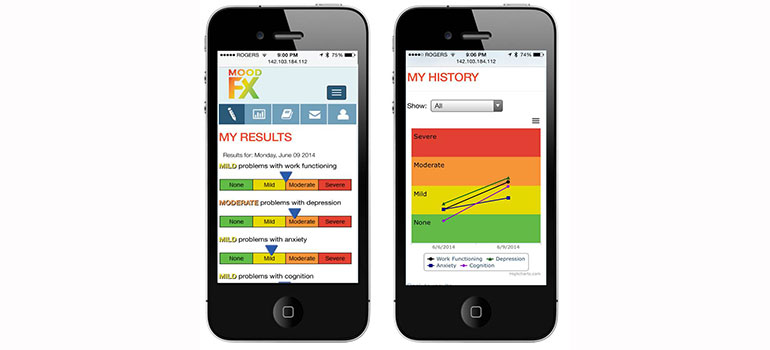
Mobile mood-tracking website helps patients across Canada
Sunday, May 31, 2015
Your smartphone could be good for your mental health

Friday, May 29, 2015
Could better tests have predicted the rare circumstances of the Germanwings crash? Probably not

Thursday, May 28, 2015
Hallucinations and delusions more common than thought

An international study led by The University of Queensland and Harvard Medical School has found that hearing voices and seeing things that others cannot see impacts about five per cent of the general population at some point in their lives.
Saturday, May 23, 2015
Substance Use disorders, not Mental Disorders, Predict Future Violence in Youth
.jpg/120px-Day_294_-_West_Midlands_Police_-_Film_project_with_young_people_in_Birmingham_(8102717350).jpg)
Friday, May 15, 2015
Is the long term use of psychiatric drugs harmful?

Tuesday, January 20, 2015
Penn Medicine Bioethicists Call for Return to Asylums for Long-Term Psychiatric Care
University of Pennsylvania. US: As the United States population has doubled since 1955, the number of
inpatient psychiatric beds in the United States has been cut by nearly
95 percent to just 45,000, a wholly inadequate equation when
considering that there are currently 10 million U.S. residents with
serious mental illness.
Subscribe to:
Comments (Atom)