BMJ: Getting a tattoo may have some unexpected complications if your immune system isn’t up to scratch, warn doctors in the journalBMJ Case Reports. The
warning comes after they treated a woman for chronic pain in her left
hip, knee and thigh some months after she had been tattooed. She had been taking drugs to dampen down her immune system for several years after receiving a double lung transplant in 2009.
Showing posts with label immunity. Show all posts
Showing posts with label immunity. Show all posts
Wednesday, June 27, 2018
Wednesday, May 23, 2018
Fighting life-threatening bacteria without antibiotics
Bonn: Researchers at the University of Bonn and the Technical
University of Munich discover the cause of infections in patients with
cirrhosis of the liver. Patients suffering from liver cirrhosis often die
of life-threatening bacterial infections. In these patients the immune
cells are unable to eliminate the bacterial infections. Scientist at the
University of Bonn and TU Munich have now discovered that type I IFN
released by immune cells due to increased migration of gut bacteria into
the cirrhotic liver incapacitate the immune system. Based on their
findings, such life-threatening infections can be contained by
strengthening the immune response alone – without antibiotics. The
results have now appeared in the journal "Gut".
Natural killer cells have a memory
.jpg/1280px-Human_Natural_Killer_Cell_(29120480442).jpg)
Bonn: Researchers at the Universities of Bonn and Munich decode an autoimmune mechanism. Researchers at the University of Bonn and the
Ludwig-Maximilians-Universität of Munich have decoded a new mechanism of
how the immune system can specifically attack pigmented cells of the
skin. It was previously believed that so-called natural killer cells did
not have an immunological memory for the body's own tissues. However,
the scientists have now been able to show that these special immune
cells can indeed “remember” pigmented cells when they come into more
frequent contact with a specific contact allergen. These results may
provide new insights into the development of the skin-depigmenting
disease vitiligo but may also offer new options for the treatment of
malignant melanoma. These results have now been published in the
renowned scientific journal “Immunity”.
Wednesday, March 14, 2018
How MRSA infection can permanently harm immune function
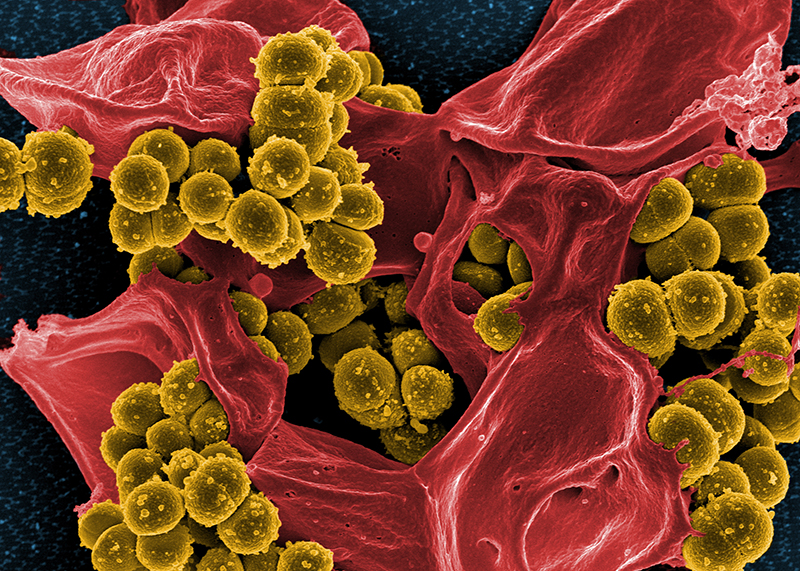
“We found that MRSA produces toxins that kill the muscle cells critical to the pumping of lymph,” said senior study author Timothy Padera, HMS associate professor of radiation oncology at Mass General.
Thursday, February 16, 2017
The yin-yang of cancer and infectious disease
Wednesday, January 25, 2017
GPS for tracking immune cells

Monday, November 7, 2016
what are antibodies and why are viruses like dengue worse the second time?

But there’s another way the immune system can fail us – by throwing down the welcome mat for viruses on their second invasion.
Sunday, May 31, 2015
Genetically modified immune cells with ‘suicide genes’ designed to attack cancers

Sunday, May 24, 2015
How the Immune System Controls the Human Biological Clock in Times of Infection
 Pennsylvania: An important link between the human body clock and the immune system
has relevance for better understanding inflammatory and infectious
diseases, discovered collaborators at the Perelman School of Medicine at the University of Pennsylvania and Trinity College, Dublin. In a study published this week in the Proceedings of the National Academy of Sciences,
they report how a critical white blood cell called the macrophage,
when exposed to bacteria, makes the biological clock inside the
macrophage stop, allowing it to become inflamed.
Pennsylvania: An important link between the human body clock and the immune system
has relevance for better understanding inflammatory and infectious
diseases, discovered collaborators at the Perelman School of Medicine at the University of Pennsylvania and Trinity College, Dublin. In a study published this week in the Proceedings of the National Academy of Sciences,
they report how a critical white blood cell called the macrophage,
when exposed to bacteria, makes the biological clock inside the
macrophage stop, allowing it to become inflamed.Bursting the Bubble of Bubble Baby Disease

Tuesday, March 24, 2015
Zinc deficiency linked to immune system response
Monday, March 16, 2015
Extreme close-up on immunity (video)
UNSW: Every second our immune cells make life or death decisions to activate or not. How do we switch these cells on? UNSW Professor Katharina Gaus investigates.
Wednesday, February 25, 2015
Scientists uncover new role for neurotransmitter that helps fight infection
Imperial College. UK: Scientists have shed new light on the
complexities of the immune system that could help develop vaccines to
boost natural defences against disease.
Tuesday, February 17, 2015
NIH researchers reveal link between powerful gene regulatory elements and autoimmune diseases
NIH. US: Investigators with the National Institutes of Health have discovered
the genomic switches of a blood cell key to regulating the human
immune system. The findings, published in Nature today, open the door
to new research and development in drugs and personalized medicine to
help those with autoimmune disorders such as inflammatory bowel disease
or rheumatoid arthritis.
Monday, February 9, 2015
Scientists identify a new population of regulatory T-cells
Mainz University. Germany: Discovery improves understanding of the cause of allergic asthma and may serve as an early diagnostic marker. When the mucosal surfaces in the lungs of healthy people come into
contact with allergenic substances, so-called regulatory T cells also
known as Treg cells, are activated. These are capable of actively
preventing the development of allergies. However, if these regulatory
mechanisms malfunction the cells of the immune system attack innocuous
substances which enter the body from the environment, ultimately leading
to the development of atopic diseases such as allergic asthma. In
western countries, asthma is the most common chronic disease in children
under the age of 15 years.
The secrets of the immune system explored using Nobel prize-winning technology
Karolinska Institute. Sweden: The inventors of the nanoscope were
awarded the Nobel Prize in Chemistry last year. The new technology of
super-resolved fluorescence microscopy has made it possible to study
molecules on a nanoscale.
It is for example possible to look at how proteins form
aggregates in Parkinson’s disease, or what the connections between the
nerve cells of the brain look like.
This technology is now also being used within immunology to
study the cells of the immune system.
Tuesday, February 3, 2015
Monday, February 2, 2015
Skin Microbes and the Immune Response
NIH. US: Skin is a barrier that serves as one of the body’s first lines of
defense against harmful microbes. Specialized immune cells within skin
tissue help to fight invading organisms. Yet the skin hosts diverse
communities of beneficial bacteria, collectively known as the skin
microbiota. These microbes that naturally colonize the skin are referred
to as commensals.
Friday, January 16, 2015
Environment, not genes, plays starring role in human immune variation, study finds
Stanford University. US: Improving gene-sequencing technologies have focused immunologists’
attention on the role of genes in diseases. But it appears the
environment is an even greater factor in the human immune response.. A study of twins conducted by Stanford University School of Medicine
investigators shows that our environment, more than our heredity, plays
the starring role in determining the state of our immune system, the
body’s primary defense against disease. This is especially true as we
age, the study indicates.
Thursday, January 15, 2015
Tumor suppressor protein plays key role in maintaining immune balance
St. Jude Children’s Research Hospital scientists have discovered that
a protein widely known for suppressing tumor formation also helps
prevent autoimmune diseases and other problems by putting the brakes on
the immune response. The research was published recently online ahead of
print in the scientific journal Nature Immunology.
Subscribe to:
Posts (Atom)