Cochrane: The aim of this Cochrane Review was to determine whether cataract
surgery is safe and improves vision in eyes with age-related macular
degeneration (AMD) compared with no surgery. Cochrane researchers
collected and analyzed all relevant studies to answer this question and
included two studies. Although data from two small studies suggest that surgery to
remove cataracts in eyes with AMD may improve vision without worsening
of AMD, it is not possible to draw reliable conclusions from the
available data at this time. Physicians must decide whether to recommend cataract surgery to their AMD patients based on clinical judgment until larger studies have been conducted and their findings published.
Showing posts with label AMD. Show all posts
Showing posts with label AMD. Show all posts
Thursday, March 2, 2017
Wednesday, June 17, 2015
Excessive Iron in Cells with AMD, Other Diseases
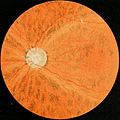 Kentucky: In a new University of Kentucky study
published yesterday in Cell Reports, a leading scientific journal in
cell biology, researchers describe a new molecular mechanism that
contributes to age-related macular degeneration (AMD) due to
accumulation of excessive iron within the cells of the retina. Cells
of the body use iron in dozens of normal metabolic processes. However,
excessive iron or "iron overload" can be very damaging to cells and
tissues and is implicated in numerous diseases, including AMD.
Kentucky: In a new University of Kentucky study
published yesterday in Cell Reports, a leading scientific journal in
cell biology, researchers describe a new molecular mechanism that
contributes to age-related macular degeneration (AMD) due to
accumulation of excessive iron within the cells of the retina. Cells
of the body use iron in dozens of normal metabolic processes. However,
excessive iron or "iron overload" can be very damaging to cells and
tissues and is implicated in numerous diseases, including AMD. Friday, May 29, 2015
Lowering risk of Age-related macular degeneration with "Oriental pattern"

Tuesday, January 20, 2015
Major cause of blindness linked to calcium deposits in the eye
University College London. UK: Microscopic spheres of calcium phosphate have been linked to the
development of age-related macular degeneration (AMD), a major cause of
blindness, by UCL-led research.
Monday, February 25, 2013
Age-related macular degeneration (AMD) Overview

The third leading global cause of blindness (after cataracts and glaucoma) is age-related macular degeneration (AMD).
This group of conditions is characterized by lesions in the macular (central) region of the retina, the tissue at the back of the eye that converts light into electrical messages and sends them to the brain.
AMD, which affects older people, destroys the sharp central vision that is needed for reading or driving, leaving only dim, blurred images or a black hole at the center of vision.
AMD can be diagnosed by examining digital photographs of the retina or by examining the retina directly using a special magnifying lens (slit lamp biomicroscopy).
There is no cure for AMD, although injections into the eye of certain drugs, such as bevacizumab, that block the activity of vascular endothelial growth factor can slow the rate of vision loss caused by some forms of AMD.
Subscribe to:
Comments (Atom)