
Showing posts with label MRI. Show all posts
Showing posts with label MRI. Show all posts
Wednesday, March 8, 2017
Early brain changes may help predict autism among high-risk infants
Monday, February 27, 2017
Screening MRI Benefits Women at Average Risk of Breast Cancer

Monday, February 20, 2017
Revolutionary ‘miniature’ MRI scanner for babies tested
 Sheffield: A ground breaking prototype ‘miniature’ MRI scanner for
babies has been installed at The Jessop Wing Maternity Hospital in
Sheffield. The
scanner, which is one of only two in the world, is part of a two-year
research project into the feasibility and benefits of scanning babies in
the neonatal unit.
Sheffield: A ground breaking prototype ‘miniature’ MRI scanner for
babies has been installed at The Jessop Wing Maternity Hospital in
Sheffield. The
scanner, which is one of only two in the world, is part of a two-year
research project into the feasibility and benefits of scanning babies in
the neonatal unit.
Paul Griffiths, Professor of Radiology at the University of Sheffield and Honorary Consultant at Sheffield Teaching Hospitals NHS Foundation Trust, and Martyn Paley, Professor of BioMedical Imaging also at the University of Sheffield, have been working on the concept and design of the scanner for 12 years.
Friday, February 17, 2017
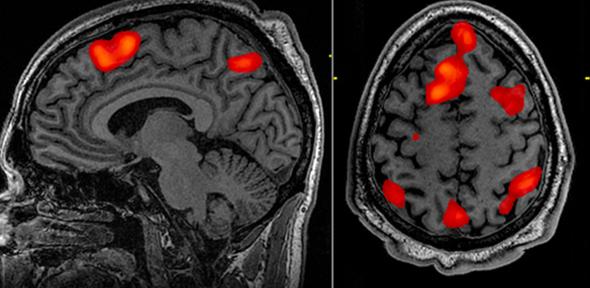
Brain scanners allow scientists to ‘read minds’ – could they now enable a ‘Big Brother’ future?
Thursday, February 16, 2017
Video: Starring the Wiring Diagram of the Human Brain
Visualization of real MRI brain scan data from a single person, showing nerve
fiber bundles near or feeding into part of the hippocampus.
Wednesday, February 15, 2017
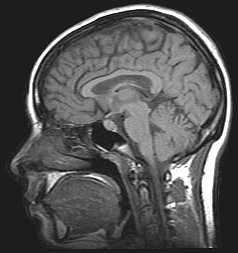
MRI brain scans may help identify risks, prevent adolescent substance abuse
Friday, June 5, 2015
MRI Technology Reveals Deep Brain Pathways in Unprecedented Detail
 Duke: Scientists at Duke Medicine have produced a 3-D map of the human
brain stem at an unprecedented level of detail using MRI technology. In a study to be published June 3 in Human Brain Mapping, the
researchers unveil an ultra high-resolution brain stem model that could
better guide brain surgeons treating conditions such as tremors and
Parkinson’s disease with deep brain stimulation (DBS).
Duke: Scientists at Duke Medicine have produced a 3-D map of the human
brain stem at an unprecedented level of detail using MRI technology. In a study to be published June 3 in Human Brain Mapping, the
researchers unveil an ultra high-resolution brain stem model that could
better guide brain surgeons treating conditions such as tremors and
Parkinson’s disease with deep brain stimulation (DBS).Is magnetic resonance imaging of human brain is harmful?
Monday, May 4, 2015
Solving the prostate predicament with an MRI

Tuesday, April 7, 2015
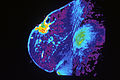
Breast cancer screening: 90 per cent of all cancers can be detected with MRI
Tuesday, February 17, 2015
Welcome to the World of Wearable Electronics
Berkeley University. US: An infant born three months prematurely fails to flush pink at birth and
has an alarmingly low blood pressure. Ultrasound identifies a heart
abnormality and doctors rush the newborn to an MRI suite to confirm the
diagnosis. But the scanning itself can cause physical agitation that
interferes with clear imaging. In some cases, it can make it harder for
the baby to breathe.
Friday, February 13, 2015
DVD reduces MRI patients’ anxiety and improves scan quality
Manchetser University. UK: A DVD designed to help people prepare for a Magnetic Resonance Imaging
(MRI) scan, including guidance on how to relax, has led to more
successful scans. The patients receiving the DVD also felt less anxious
during the scan says a paper published in the British Journal of Health
Psychology.
Thursday, February 5, 2015
MRI Technique Developed for Nonalcoholic Fatty Liver Disease in Children
UCSD. US: Between 5 and 8 million children in the United States have
nonalcoholic fatty liver disease (NAFLD), yet most cases go undiagnosed.
To help address this issue, researchers at UC San Diego School of
Medicine have developed a new magnetic resonance imaging (MRI)-based
technique to help clinicians and researchers better detect and evaluate
NAFLD in children. The study is published Feb. 5 in Hepatology.
Monday, January 26, 2015
Quantum Leap in Diagnosis of Disease
Bonn University. Germany: A state-of-the-art diagnosis system is now
being introduced at the University of Bonn's Radiological Clinic: the
first of its kind worldwide, it is a new type of high-field nuclear
magnetic resonance tomography spectrometer which opens up completely new
possibilities both for clinical application to patients, for clinical
research and pure research. Philips have placed the multi-million euro
spectrometer at the University's disposal; the Radiological Clinic beat
rival applicants from the US, Japan and Europe.
Tuesday, January 20, 2015
Inflatable MRI Scanner
King’s College London (UK) has become the first London university to
acquire an inflatable MRI scanner to help children overcome their
anxiety and practice lying still for 30 minutes before they enter a real
MRI scanner.
MRI could predict Alzheimer’s disease, improving treatment
Queensland University. Australia: Scientists at the
University of Queensland have discovered that magnetic resonance imaging
(MRI) could be used to predict the risk of Alzheimer’s disease. The discovery could greatly improve outcomes for Alzheimer’s
patients, as early diagnosis could increase the effectiveness of drug
treatments.
Sunday, January 18, 2015
MRI: Window into the brain
Melbourne University. Australia: Magnetic Resonance Imaging, or MRI, has revolutionized modern medicine, allowing us to see detailed structure of the human brain. PhD students Charles Malpas and Bernd Merkel discuss their research into applying MRI as a tool to investigate diseased and healthy brains to help fine tune our understanding of how the brain works. Presented by Sila Genc.
Subscribe to:
Comments (Atom)