 Ann Arbor: Michigan Medicine researchers employ novel technology to monitor
vulnerabilities for cardiovascular events, aid in diagnosis and
treatment.. Strokes
and heart attacks often strike without warning. But, a unique
application of a medical camera could one day help physicians know who
is at risk for a cardiovascular event by providing a better view of
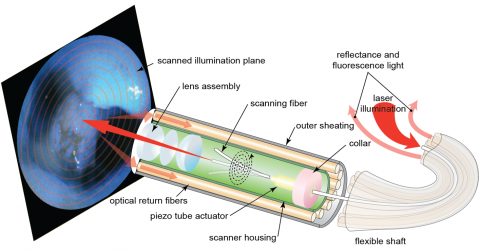
potential problem areas.A new paper in Nature Biomedical Engineering (link is external) reports proof-of-concept results for this new imaging platform for atherosclerosis.
Ann Arbor: Michigan Medicine researchers employ novel technology to monitor
vulnerabilities for cardiovascular events, aid in diagnosis and
treatment.. Strokes
and heart attacks often strike without warning. But, a unique
application of a medical camera could one day help physicians know who
is at risk for a cardiovascular event by providing a better view of
potential problem areas.A new paper in Nature Biomedical Engineering (link is external) reports proof-of-concept results for this new imaging platform for atherosclerosis.
Showing posts with label atherosclerosis. Show all posts
Showing posts with label atherosclerosis. Show all posts
Wednesday, February 15, 2017
Laser-based camera improves view of the carotid artery
Ann Arbor: Michigan Medicine researchers employ novel technology to monitor
vulnerabilities for cardiovascular events, aid in diagnosis and
treatment.. Strokes
and heart attacks often strike without warning. But, a unique
application of a medical camera could one day help physicians know who
is at risk for a cardiovascular event by providing a better view of
potential problem areas.A new paper in Nature Biomedical Engineering (link is external) reports proof-of-concept results for this new imaging platform for atherosclerosis.Wednesday, January 18, 2017
Engineering nanomaterials to deliver treatments for heart disease

Tuesday, January 17, 2017
Researcher traces molecular association between BPA exposure and atherosclerosis
Wednesday, May 27, 2015
Cellular therapy promising treatment for arteriosclerosis
Wednesday, February 25, 2015
Antiplatelet agents for preventing failure of peripheral arterial grafts
Cochrane: Symptomatic peripheral arterial disease in people with atherosclerosis can present as intermittent claudication, disabling pain on walking, or as critical limb ischaemia with pain at rest, ulceration, gangrene and the risk of losing a leg. One treatment option is to implant
a graft or makeshift blood vessel to bypass a blockage in the main
artery of the thigh. Using a section of the vein from the patient's leg
is often better than artificial or prosthetic materials such as Dacron
or polytetrafluoroethylene, which take up platelets
that could lead to clotting that could block the graft.
Saturday, February 21, 2015
Keeping Atherosclerosis in-check with Novel Targeted Inflammation-Resolving Nanomedicines
Brigham Hospital. US: Nanometer-sized “drones” that deliver a special type of healing
molecule to fat deposits in arteries could become a new way to prevent
heart attacks caused
by atherosclerosis, according to a study in pre-clinical models by
scientists at Brigham and Women’s Hospital (BWH) and Columbia University
Medical Center.
These findings are published in the February 18th online issue of Science Translational Medicine.
Thursday, February 19, 2015
Nano Drones Deliver
Harvard University. US: Nanometer-sized “drones” that deliver a special type of healing
molecule to fat deposits in arteries could become a new way to prevent
heart attacks caused by atherosclerosis, according to a study in
preclinical models by scientists at Harvard Medical School, Brigham and
Women’s Hospital and Columbia University. These findings were published
Feb. 18 in Science Translational Medicine.
Monday, February 9, 2015
Cleaner protein protects against atherosclerosis
Lund University. Sweden: We have an innate mechanism that ensures that our blood vessels do not become blocked. The protein A1M, alpha-1-microglobulin, is naturally present in the body and prevents oxidation of blood fats – a major cause of atherosclerosis. The discovery is the work of a research group led by Professor Bo Åkerström from Lund University.
Subscribe to:
Comments (Atom)