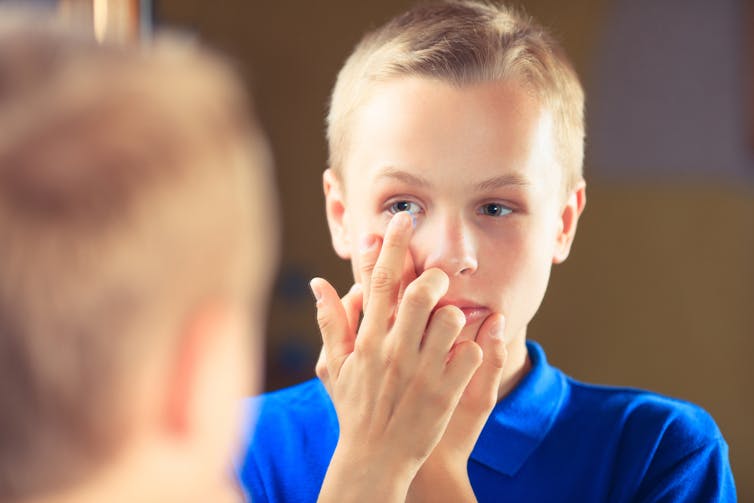
TheConversation: Short-sightedness is a global public health problem. Most people
think of myopia (the medical term for short-sightedness) as an
inconvenience because the blurred vision it causes is easily corrected
with glasses or contact lenses. The problem is that a myopic eye is a
longer eye and so the light sensitive part at the back of the eye is
stretched. This can lead to a number of eye diseases in later life, such
as glaucoma, maculopathy and retinal detachment.
Only good, independent and reliable information about health from experts.
Showing posts with label myopia. Show all posts
Thursday, March 2, 2017
Wednesday, December 14, 2016
Increased UVB Exposure Associated with Reduced Risk of Nearsightedness, Particularly In Teens, Young Adults
JAMA: Higher ultraviolet B (UVB) radiation exposure, directly related to
time outdoors and sunlight exposure, was associated with reduced odds of
myopia (nearsightedness), and exposure to UVB between ages 14 and 29
years was associated with the highest reduction in odds of adult myopia,
according to a study published online by JAMA Ophthalmology.
Thursday, November 24, 2016
New Visual Symptoms Following LASIK Surgery
JAMA: In a study published online by JAMA Ophthalmology, Malvina
Eydelman, M.D., of the U.S. Food and Drug Administration, Silver Spring,
Md., and colleagues examined the frequency of patient-reported visual
symptoms, dry eye symptoms, satisfaction with vision, and satisfaction
with laser insitu keratomileusis (LASIK) surgery in the Patien
Thursday, November 3, 2016
Children’s eyesight worsening sooner than previous generations
Waterloo: Spending one additional hour per week outdoors significantly lowers odds of nearsightedness. New research from the University of Waterloo’s School of Optometry
and Vision Science and CNIB found nearsightedness in children increases
drastically from Grade 1 to Grade 8, with almost a third of the cases
going undiagnosed and uncorrected. The landmark study, entitled Myopia Prevelence in Canadian School
Children, found nearsightedness—also known as myopia—increases from six
per cent to 28.9 per cent between the ages of six and 13. Children from
the Waterloo Region District School Board and Waterloo Catholic District
School Board participated in the landmark study, with 17.5 per cent of
them being nearsighted.
Tuesday, May 26, 2015
Long periods reading is associated with a greater risk of myopia.
Scimex: A major study has revealed that more than four out of five Chinese
students suffer from myopia and researchers warn Australia could see
similar rates of short sightedness in the future. "There are many factors that appear to influence the likelihood of a child developing myopia," Professor Wang from Edith Cowan University said. "Spending long periods reading material that is within 30cm of the readers' face is associated with a greater risk of myopia.
Tuesday, May 12, 2015
Short-sightedness becoming more common across Europe
London: Myopia or short-sightedness is becoming more common across Europe,
according to a new study led by King’s College London. The
meta-analysis of findings from 15 studies by the European Eye
Epidemiology Consortium found that around a quarter of the European
population is short-sighted but it is nearly twice as common in younger
people, with almost half (47 per cent) of the group aged between 25 and
29 years affected.
Tuesday, April 14, 2015
Is it possible to predict myopia in children?
JAMA: According
to US researchers, a simple test performed in children
can predict if a child will become myopic in adolescence. This information is provided by the refractive error, according to a study published in the journal "JAMA Ophthalmology." Scientists
from the University of Ohio, Columbus, analyzed data from 4,500
students, from first grade until eighth grade in the United States,
which had been collected over a period of 20 years. The vision of the participants was assessed at baseline and again at two follow-up studies. The
researchers then analyzed whether any of the 13 risk factors could predict significantly the risk of developing myopia later. Eight factors were indeed associated with an increased risk of visual impairment. For example, the risk was higher if both parents were myopic. Surprisingly, close work such as reading or watching television had no influence.However, the rate of refractive error turned out to be the best predictor. Children whose eyes have normal growth should actually be slightly farsighted. If it were not, or only to a very small extent, the risk of myopia at a
young age (up to age 13 years) was significantly increased.Although
the frequency of myopia varies between different ethnic groups, the
refractive error proved to be a reliable predictor in all cases. Thus, mandatory vision testing would be relevant, the study authors concluded. Parents of children at higher risk could then provide more regular eye exams.
Subscribe to:
Comments (Atom)

