Showing posts with label alcohol. Show all posts

Tuesday, March 7, 2017

Animal Study Suggests Alcohol Use Before Pregnancy May Increase Vulnerability of Offspring to Stress in Adulthood

NIAAA: The effects of alcohol use during pregnancy on an unborn child are well known. However, a recent NIAAA-funded study in rats has shown that a mother’s alcohol use before conception also could have negative effects on her child’s health and response to stress during adulthood. To study the effects of preconception alcohol use, the research team, led by Dipak Sarkar, Ph.D., at Rutgers University, gave female rats 4 weeks of access to a diet containing 6.7 percent alcohol, which raised their blood alcohol levels similar to that of binge drinking in humans.

Thursday, March 2, 2017

Brainy teens may be less likely to smoke, but more likely to drink and use cannabis

BMJ: Brainy teens may be less likely to smoke, but more likely to drink alcohol and use cannabis, than their less academically gifted peers, suggests research published in the online journal BMJ Open. These patterns persist into adulthood, and would seem to refute the notion that academic prowess is associated with a greater tendency to ‘experiment’ for a brief period, suggest the researchers. Smoking, drinking, and cannabis use are fairly common among teenagers. And the evidence suggests that these behaviours boost the risk of immediate and longer term health problems. But the data on potential links between cleverness and substance use are somewhat mixed, and no study has tracked patterns with use of all three substances from early adolescence into early adulthood.

Monday, February 20, 2017

Your health! The benefits of social drinking

Oxford: New research, which shows that moderate alcohol consumption with friends at a local pub may be linked to improved wellbeing, has been published in the journal Adaptive Human Behaviour and Physiology. While most studies warn of the health risks of alcohol consumption, researchers at the University of Oxford have looked at whether having a drink may play a role in improving social cohesion, given its long association with human social activities. Combining data from three separate studies - a questionnaire-based study of pub clientele, observing conversational behaviour in pubs, and a national survey by the Campaign for Real Ale (CAMRA) – the researchers looked at whether the frequency of alcohol consumption or the type of venue affected peoples’ social experiences and wellbeing.

Wednesday, December 21, 2016

How to know when holiday drinking is hurting your brain

TheConversation: For many, the holidays are indeed the most wonderful time of the year. Families and friends come together and enjoy food, good cheer – and, often, alcohol. Commercially speaking, alcohol and the holidays seem to be made for each other. Alcohol can be a quick and easy way to get into the spirit of celebration. And, it feels good. After two glasses of wine, the brain is activated through complex neurobiochemical processes that naturally release dopamine, a neurotransmitter of great importance. When the dopamine molecule locks on to its receptor located on the surface of a neuron, or basic brain cell, a “buzz” occurs. It is often desirably anticipated before the second glass is empty.

Friday, December 16, 2016

Changing lifestyle could lower bowel cancer risk

Scimex: Bowel cancer rates could be considerably reduced by tackling obesity, alcohol consumption, smoking and red and processed meat consumption alongside increased physical activity, according to New Zealand researchers. Colorectal cancer accounts for almost 10 per cent of cancers worldwide, but New Zealand has one of the highest rates. The new study calculated the relative risks for several factors and found obesity and alcohol consumption were the most important modifiable lifestyle factors. In an accompanying editorial, University of Otago scientists cautioned against using this information to "victim blame" those affected by cancer. Instead, it was crucial for government to "accept the reality that riskfactors for cancer can be modified by a public health response."

Wednesday, November 23, 2016

Schoolies risking health with alcohol and energy drink mix

TheConversation: Young people are fuelling big nights out by drinking alcohol mixed with energy drinks to help them party through the night, according to a new Victorian government report. The VicHealth report found that people who mix their alcohol with energy drinks are also more likely to be problem gamblers, show other risk-taking behaviour such as heavy alcohol use or illicit drug use, and report more mental health problems. Executive Manager Dr Bruce Bolam from VicHealth, which funded the studies, said while overall levels of consumption of these products was relatively low compared to beer or wine in the wider population, in young people the level of consumption was very high.

Tuesday, November 15, 2016

The more you drink, the greater your risk of prostate cancer

Scimex: A collaborative study published today provides new evidence of a significant link between alcohol consumption and the risk of prostate cancer. The article, Is alcohol consumption a risk factor for prostate cancer? A systematic review and meta–analysis, appears in BMC Cancer, a peer-reviewed, online journal. Conducted by researchers at the National Drug Research Institute (NDRI) at Curtin University in Perth and the Centre for Addictions Research of BC (CARBC) at the University of Victoria (UVic) in Canada, the study shows that even low volume drinking can increase the risk of prostate cancer.

Tuesday, June 30, 2015

Clinical trial of new medication for alcohol use disorder

NIH: A clinical trial investigating a potential treatment for alcohol use disorder (AUD) was announced by the National Institute of Alcohol Abuse and Alcoholism (NIAAA). The study will assess the safety and efficacy of gabapentin enacarbil (HORIZANT) in extended-release tablets for treating moderate to severe AUD. NIAAA is part of the National Institutes of Health.

Tuesday, June 16, 2015

Majority of adults favor ban on powdered alcohol, concerned it would increase underage drinking

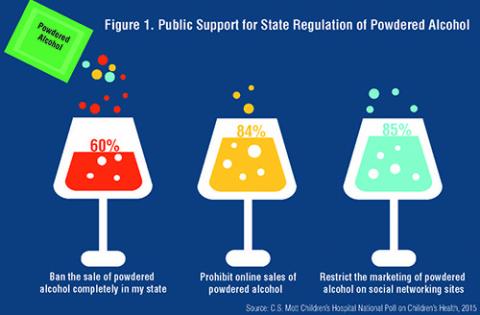
powdered alcoholAnn Arbor: 90% of adults concerned about misuse of powdered alcohol among underage youth; more than three quarters support banning online sales. After this year’s legalization of powdered alcohol, some states have already banned it – a move that the majority of the public supports, according to a new University of Michigan C.S. Mott Children's Hospital National Poll on Children's Health. Adults across the country share the same top concern about the new alcohol-on-the-go product: potential misuse among underage youth.

Saturday, June 13, 2015

State Policies On Alcohol Can Lower Youth Drinking

American Academy of Pediatrics: Alcohol is the most commonly used drug among teens, and accounts for more than 4,300 deaths annually among people under age 21. In a study, “Youth Drinking in the United States: Relationships With Alcohol Policies and Adult Drinking,” published in the July 2015 Pediatrics (published online June 1), researchers examined 29 different state policies on alcohol – such as higher alcohol taxes or laws governing the density of liquor stores -- and measured their impact on the prevalence of youth drinking and binge drinking in states. Researchers found population-oriented alcohol policies (i.e., those that do not target youth specifically) were associated with lower youth drinking prevalence and binge drinking prevalence. This was partly explained by the impact of such laws in reducing adult drinking. Researchers conclude that state alcohol policies, including those that do not target youth specifically, are linked to lower youth drinking and binge drinking. According to the study authors, the findings suggest that comprehensive policy strategies that target the general population as well as youth are needed to reduce youth alcohol consumption and related problems.

Thursday, June 4, 2015

Alcohol Use Disorder is Widespread, Often Untreated in the United States

JAMA: Alcohol use disorder as defined by a new diagnostic classification was widespread and often untreated in the United States, with a lifetime prevalence of 29.1 percent but only 19.8 percent of adults were ever treated, according to an article published online by JAMA Psychiatry. Alcohol use disorders are among the most prevalent mental health disorders worldwide, resulting in disability and contributing to illness and death. Because of the seriousness of alcohol use disorders, updated epidemiologic data are needed given the changes to the alcohol use disorder diagnostic criteria in the Diagnostic and Statistical Manual of Mental Disorders, 5th edition (DSM-5).

Saturday, May 30, 2015

Moderate drinking in later years may damage heart

American Heart Association: Drinking two or more alcoholic beverages daily may damage the heart of elderly people, according to research in the American Heart Association journal Circulation: Cardiovascular Imaging. The study correlated weekly alcohol consumption among 4,466 people — average age 76 — to the size, structure and motion of various parts of the heart.

Restricting firearms access for people who misuse alcohol may prevent violence

Loonylabs: Restricting access to firearms for people who misuse alcohol could prevent firearm violence, but policies that more clearly define alcohol misuse should be developed to facilitate enforcement, according to a review of existing research and public policies by the UC Davis Violence Prevention Research Program.

The analysis summarizes studies on binge drinking and other forms of alcohol misuse in association with firearm access and use, including firearm violence. It also describes the shortcomings of existing policies designed to restrict access to firearms among those who are at high risk for violence due to alcohol misuse–particularly people with multiple prior convictions for alcohol-related offenses such as driving while under the influence (DUI).

Thursday, May 28, 2015

Did the alcopops tax do the trick in reducing alcohol related harm for young people?

UNSW: Hospital emergency department presentations for young people significantly decreased following the introduction of the alcopops tax in 2008, according to a new UNSW-led study published in the journal BMC Public Health. The study is the first to examine the longer term impact of the Goods and Services Tax (GST) and subsequent alcopops tax on alcohol harm in New South Wales. It shows that increasing alcohol taxes can reduce harms associated with binge drinking, and not just decrease levels of alcohol consumption.

Wednesday, May 27, 2015

Research reveals social media skews drinking habits

Sydney: Social media is a cause, and a solution to young people's binge drinking habits according to new research from the University of Sydney. The study reveals that exaggerated 'boozy' Facebook profiles are exacerbating drinking habits in young people, but correcting these misperceptions among peer groups can reduce drinking by up to 50 per cent.

Tuesday, May 26, 2015

Holidays and parties mean we may drink more than we think

NHS: "The amount of alcohol people in England drink has been underestimated by the equivalent of 12 million bottles of wine a week," BBC News reports. It has long been known there is a big gap between the amount people say they drink in national surveys, like the Health Survey for England, and the amount of alcohol known to be sold in England. In this new survey researchers set out on the assumption that while people may accurately report their standard drinking patterns from week to week, they may forget the drinking they do on special occasions, such as bank holidays, parties, weddings, wakes or big sporting events (which, for many England fans, is akin to a wake).

Monday, May 25, 2015

Alcohol brands breach advertising codes online

FARE: New research shows alcohol brands continue to regularly breach industry advertising codes on Facebook and has drawn further attention to the inadequacies of the current self-regulatory system. The study found the Facebook pages of Australia’s most popular alcohol brands are filled with highly inappropriate content that glamorises and encourages excessive drinking and features crude and offensive language, and derogatory, vilifying and sexist remarks.

Thursday, May 21, 2015

The dark side of the 'love hormone'; research points to striking similarities with the effects of alcohol

Birmingham: Researchers at the University of Birmingham have highlighted significant similarities between the behavioural effects of oxytocin and alcohol. The research, published today in Neuroscience and Biobehavioral Reviews, draws on existing studies into the two compounds and details the similarities between the effects of alcohol  and the ‘love hormone’, oxytocin, on our actions. The team warn that the oft-used nickname hides the darker side of oxytocin, and claim that it bears more semblances with the effects of alcohol than previously thought.

Don’t believe the hype, teens are drinking less than they used to

TheConversation: Ask your friends and colleagues about young Australians and alcohol and I bet they’ll say something about a generation out of control or a binge-drinking epidemic. The media regularly brings the worst outcomes of young people’s drinking to our attention and points to a problematic drinking culture supposedly unique to young Australians. Little wonder people believe things have never been so bad. The reality is startlingly different. Data recently released by the Australian Bureau of Statistics shows alcohol consumption in Australia has reached its lowest point since the early 1960s, having declined steadily since the mid-2000s. Survey data suggests this decline has been driven almost entirely by reductions in youth drinking.

Tuesday, May 19, 2015

Exposure To Alcohol In Early Pregnancy May Cause Lifelong Adult Brain Changes

TheConversation: Dr. Nina Kaminen-Ahola Ph.DThe beginning of embryonic development is vulnerable to the effects of external influences and disruption of these processes can have long-term effects on development. Our previous study demonstrated, for the first time, that alcohol exposure in early pregnancy can cause permanent changes to the epigenetic regulation, gene function and the appearance of mouse offspring. We discovered increased DNA-methylation, transcriptional silencing of an epigenetically sensitive allele Agouti viable yellow (Avy) and darker coat colour in the offspring. In this study we wanted to see whether alcohol consumed in early pregnancy causes long-term changes to the epigenome and gene expression in hippocampus.