Showing posts with label scoliosis. Show all posts
Showing posts with label scoliosis. Show all posts
Tuesday, April 28, 2015
Surgical treatment compared to non-surgical treatment for idiopathic scoliosis: no conclusion
Tuesday, January 20, 2015
A First in Quebec in the Field of Scoliosis
Montreal University. Canada: The Sainte-Justine University Hospital Center (CHU Sainte-Justine)
affiliated to Université de Montréal is now the first institution in
Québec, the second in Canada and among the world's top ten to perform a
revolutionary back surgery technique in children with scoliosis. The
number of such surgeries performed worldwide so far is less than a
hundred.
Sunday, July 27, 2014
Scoliosis
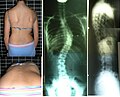
- Scoliosis is defined as a lateral curvature of the spine in the frontal plane of the body, which means that the vertebral column bends from side-to-side.
- The most common form of scoliosis (over 85% of cases) is called "idiopathic scoliosis.” This simply means that the cause is not known. Scoliosis curves of greater than 10° affect 0.5-3% of the population of the United States.
- Symptoms:
Pediatric scoliosis is usually painless. Often the curvature itself may be too subtle to even be noticed. Parents may notice abnormal posture in their growing child and the major complaint is usually a clinically apparent deformity.
Most symptoms are associated with the spine being curved.
Symptoms of scoliosis can include:
· Leaning more to one side than the other
· A rib "hump" and/or a protruding shoulder blade
· The opposite sides of the body may not appear level
· A tilted head that does not line up over the hips
· One hip or shoulder that is higher than the other, causing an uneven waist
· In developing girls, breasts appearing to be of unequal size
· Unequal distance between arms and body
· Clothes that do not "hang right," i.e., uneven hemlines
· Walking with a rolling gait - Diagnosis can include: An inclinometer (Scoliometer) measures distortions of the torso. Physical examination Radiographic evaluation (standing full-length spine posterior-anterior and lateral x-ray film).
- The three basic treatment options for AIS include: Observation, non-operative treatment and surgery. -OBSERVATION si the treatment of choice when the curvature of the spine is minimal, somewhere between 20 and 30 degrees.
-NON-OPERATIVE TREATMENT includes bracing to prevent curves from progressing, not to correct scoliosis itself, exercise that has many health benefits and is important for maintaining strength and muscle tone and stabilizing weight.
-SURGERY : Spinal fusion, also known as spondylodesis or spondylosyndesis is the most widely performed surgery for correction of scoliosis. - More about scoliosis
Saturday, April 21, 2012
Scoliosis
Author: Dr Vedat Deviren University of California San Francisco 2008-07-09
 Scoliosis:
Pediatric Scoliosis/Adult Scoliosis
Scoliosis is defined as a lateral curvature of the spine in the frontal plane of the body, which means that the vertebral column bends from side-to-side. Normally, the spine is straight. With scoliosis, the spine curves to the side in the shape of the letter “S” or “C”. This can cause small but noticeable changes in the alignment of the entire trunk of the body, and the ribs or hips may stick out more on one side than the other side. Additionally, one shoulder may be lower than the other. Furthermore, a severely scoliotic spine may create asymmetries in the shoulder, thoracic cage and pelvis leading to trunk imbalance and significant cosmetic deformity. Scoliosis curves of greater than 10° affect 0.5-3% of the adolescent population and studies reported scoliosis observed up to 32% of adult population after the age of 60.
Subscribe to:
Posts (Atom)