 Maastricht: Scientists
from the MERLN Institute, associated with Brightlands, and the Hubrecht
Institute (KNAW) have successfully created in the laboratory
embryo-like structures from mouse stem cells. These model embryos
resemble natural ones to the extent that, for the first time, they
implant into the uterus and initiate pregnancy. This radically new
method opens the door to understanding the first and hidden processes of
life, problems of infertility, or the embryonic origin of diseases.
This scientific breakthrough has been published in Nature.
Maastricht: Scientists
from the MERLN Institute, associated with Brightlands, and the Hubrecht
Institute (KNAW) have successfully created in the laboratory
embryo-like structures from mouse stem cells. These model embryos
resemble natural ones to the extent that, for the first time, they
implant into the uterus and initiate pregnancy. This radically new
method opens the door to understanding the first and hidden processes of
life, problems of infertility, or the embryonic origin of diseases.
This scientific breakthrough has been published in Nature.
Showing posts with label stem cells. Show all posts
Showing posts with label stem cells. Show all posts
Wednesday, June 20, 2018
Forming model embryos from stem cells in the lab
Maastricht: Scientists
from the MERLN Institute, associated with Brightlands, and the Hubrecht
Institute (KNAW) have successfully created in the laboratory
embryo-like structures from mouse stem cells. These model embryos
resemble natural ones to the extent that, for the first time, they
implant into the uterus and initiate pregnancy. This radically new
method opens the door to understanding the first and hidden processes of
life, problems of infertility, or the embryonic origin of diseases.
This scientific breakthrough has been published in Nature.Sunday, June 10, 2018
Researchers glimpse elusive stem cell in the early embryo

Saturday, May 12, 2018
Stem Cells Pave the Way for new treatment of diabetes
 Copenhagen: A new stem cell study conducted at the University of Copenhagen shows how we may increase the vital production of insulin in patients suffering from diabetes. The discovery helps to more efficiently at less cost make insulin-producing beta cells from human stem cells. Therefore, the research paves the way for more effective treatment of diabetes. The method may also prove significant to the treatment of a series of other diseases.
 Sunday, February 19, 2017
New technology to speed up testing of cancer drugs
Wednesday, February 15, 2017
For first time, Induced Pluripotent Stem Cell flag potential drug for blood disease

Thursday, February 2, 2017
Stem cell transplants may induce long-term remission of multiple sclerosi
NIH: New clinical trial results provide evidence that high-dose
immunosuppressive therapy followed by transplantation of a person's own
blood-forming stem cells can induce sustained remission of
relapsing-remitting multiple sclerosis (MS), an autoimmune disease in
which the immune system attacks the central nervous system.
“...these five-year results suggest the promise of this treatment for
inducing long-term, sustained remissions of poor-prognosis
relapsing-remitting MS",Richard Nash, M.D., Principal Investigator,says.
Stem cell secretions may protect against glaucoma

Wednesday, January 25, 2017
Scientists reprogram embryonic stem cells to expand their potential
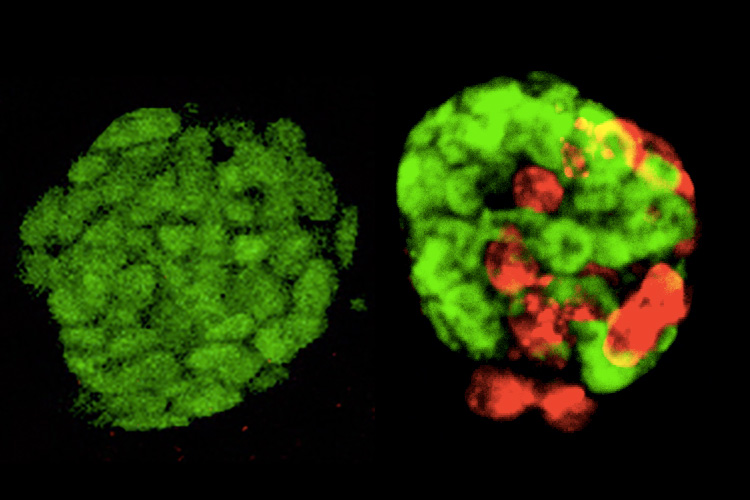 Berkeley: Researchers from UC Berkeley have found a way to reprogram mouse
embryonic stem cells so that they exhibit developmental characteristics
resembling those of fertilized eggs, or zygotes. These “totipotent-like” stem cells are able to generate not only all
cell types within a developing embryo, but also cell types that
facilitate nutrient exchange between the embryo and the mother.
Berkeley: Researchers from UC Berkeley have found a way to reprogram mouse
embryonic stem cells so that they exhibit developmental characteristics
resembling those of fertilized eggs, or zygotes. These “totipotent-like” stem cells are able to generate not only all
cell types within a developing embryo, but also cell types that
facilitate nutrient exchange between the embryo and the mother.
Diabetes impairs activity of bone stem cells in mice, inhibits fracture repair
Friday, January 6, 2017
How does the liver find its place in the body?
 Copenhagen: Organs
already find their position in the embryo, which is the earliest stage
of development of an organism. In the early embryo, each organ develops
from a group of specific group of early-stage cells, so called
progenitor cells. The cells are initially formed in the midline of the
embryo and then move either to the left or to the right in order to
place the organs in the body in the most efficient way. Progenitor cells
must therefore be able to move, receive instructions and ultimately
interact with other cells while navigating through the embryo until they
reach their final destination where they fully develop the organ.
Copenhagen: Organs
already find their position in the embryo, which is the earliest stage
of development of an organism. In the early embryo, each organ develops
from a group of specific group of early-stage cells, so called
progenitor cells. The cells are initially formed in the midline of the
embryo and then move either to the left or to the right in order to
place the organs in the body in the most efficient way. Progenitor cells
must therefore be able to move, receive instructions and ultimately
interact with other cells while navigating through the embryo until they
reach their final destination where they fully develop the organ.Friday, December 16, 2016
Surprising results on first-ever test of stem cell therapy to treat arthritis

Sunday, November 13, 2016
Stem cells - a cure for fatal muscular dystrophy

Bonn: The diagnosis 'muscular dystrophy' is
usually tantamount to a death sentence for those affected. One in three
thousand male babies suffer from this incurable hereditary disease. The
progress of the disease can only be slowed down through physiotherapy
and medication. Scientists at Bonn University and at Pittsburgh
Children's Hospital (USA) have now isolated a specific type of stem cell
which can improve the regeneration of damaged muscle cells in mice
suffering from muscular dystrophy. The results have now been published
in the prestigious Journal of Cell Biology (Vol. 157 (5), pp. 851-864).
Monday, October 31, 2016
Regenerating Muscle from Stem Cells
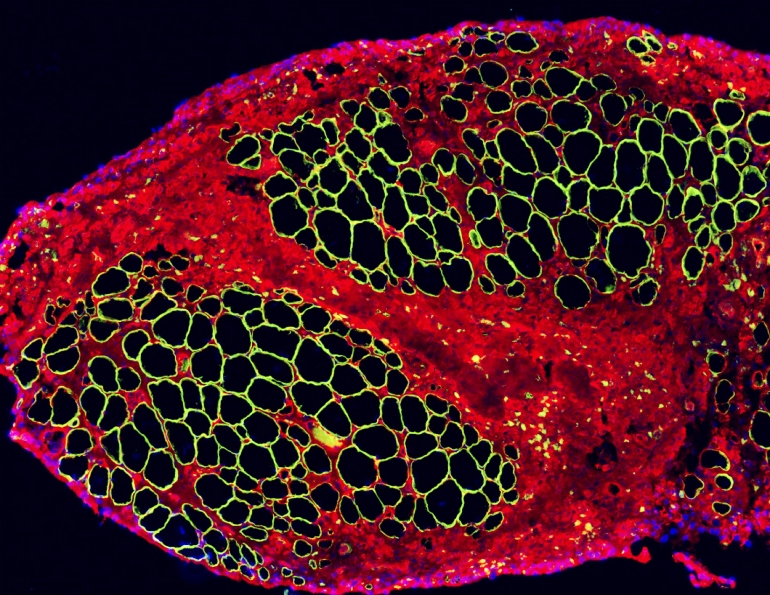
The image shows cross-sectioned muscle fibers as black shapes outlined in green. The catch: these are human muscle fibers, grown from human stem cells.
Xiaoti Xu, MD, a resident physician in UC San Francisco’s Division of Plastic and Reconstructive Surgery, studies a type of stem cell called satellite cells, or muscle stem cells. Xu became interested in muscle stem cells because of his experiences as a clinician.
Thursday, July 2, 2015
New biotechnology for high efficiency purification of live human cells

Tuesday, June 16, 2015
New biotechnology for high efficiency purification of live human cells
Thursday, June 11, 2015
Stem cell discovery paves way for targeted treatment for osteoarthritis
 York: Scientists at the University of York have made
a significant advance that could make cell-based treatments for
arthritis less of a lottery. Researchers
in the Departments of Biology and Physics at York, working with
colleagues at the Erasmus Medical Centre in Rotterdam, have identified
individual stem cells that can regenerate tissue, cartilage and bone. The
stem cells are mixed within human bone marrow stromal cells (MSCs) but
are similar in appearance and previously, scientists had difficulty in
distinguishing between them. The York researchers isolated individual
MSCs and analysed their different properties. This allowed researchers
to identify those stem cells which are capable of repairing damaged
cartilage or joint tissue opening the way for improved treatment for
arthritis.
York: Scientists at the University of York have made
a significant advance that could make cell-based treatments for
arthritis less of a lottery. Researchers
in the Departments of Biology and Physics at York, working with
colleagues at the Erasmus Medical Centre in Rotterdam, have identified
individual stem cells that can regenerate tissue, cartilage and bone. The
stem cells are mixed within human bone marrow stromal cells (MSCs) but
are similar in appearance and previously, scientists had difficulty in
distinguishing between them. The York researchers isolated individual
MSCs and analysed their different properties. This allowed researchers
to identify those stem cells which are capable of repairing damaged
cartilage or joint tissue opening the way for improved treatment for
arthritis.Saturday, May 30, 2015
Scientists correct cystic fibrosis mutation in stem cells

Wednesday, May 27, 2015
Stem cell therapy for inherited skin blistering

Thursday, May 21, 2015
Revolutionary stem cell culturing technique enables testing of drugs on patient tissue
 Utrecht: In an article published in Cell
magazine this week, researchers from the Hubrecht Institute, in
collaboration with the Sanger Institute, describe the construction of a
"living biobank” for colorectal cancer. The researchers, led by Hans
Clevers, Professor at Utrecht University, used organoid technology to
grow tumor tissue. In the future this technique can be used for
personalized medicine: offering a tailor-made treatment for the
individual patient.
Utrecht: In an article published in Cell
magazine this week, researchers from the Hubrecht Institute, in
collaboration with the Sanger Institute, describe the construction of a
"living biobank” for colorectal cancer. The researchers, led by Hans
Clevers, Professor at Utrecht University, used organoid technology to
grow tumor tissue. In the future this technique can be used for
personalized medicine: offering a tailor-made treatment for the
individual patient.Wednesday, May 20, 2015
Stem cells could provide a treatment for a broken heart

While it may sound like the subject of a decidedly odd country and western song, the headline actually refers to damage to the heart muscle. A heart attack occurs when the muscle of the heart becomes starved of oxygen causing it to be damaged. If there is significant damage the heart can become weakened and unable to effectively pump blood around the body. This is known as heart failure and can cause symptoms such as shortness of breath and fatigue. The heart contains "dormant" stem cells, and researchers want to learn more about them to work out ways to get them to help repair damaged heart tissue.
Subscribe to:
Posts (Atom)