Showing posts with label hearing loss. Show all posts
Showing posts with label hearing loss. Show all posts
Wednesday, June 27, 2018
Are Portable Music Players Associated With Hearing Loss in Children?
JAMA: The effect of portable music players on the hearing of children is
unclear. A new study found that about 1 in 7 children (9 to 11 years of
age) showed signs of noise-induced hearing impairment, prior to exposure
to known noise hazards such as club and concert attendance. Portable
music players, used by 40 percent of 2,075 children in the study from
the Netherlands, were associated with high-frequency hearing loss.
Repeated measurements are needed to confirm this association.
Wednesday, March 8, 2017
Model approach for over-the-counter hearing aids suggests benefits similar to full-service purchase
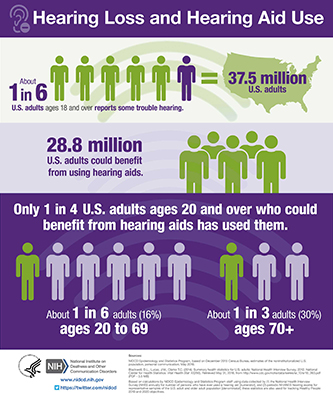 NIH: Can
over-the-counter hearing aids for older adults with mild-to-moderate
hearing loss work as well as hearing aids purchased through an
audiologist? In a new study, participants who selected pre-programmed
hearing aids using an over-the-counter delivery model reported a similar
level of benefit as participants who purchased the same hearing aids
through an audiologist following best practices. The audiology services
included fitting the hearing aids and counseling the consumers on how to
use them. The National Institute on Deafness and Other Communication
Disorders (NIDCD), part of the National Institutes of Health, supported
the study, which is published in the March 2 American Journal of Audiology.
NIH: Can
over-the-counter hearing aids for older adults with mild-to-moderate
hearing loss work as well as hearing aids purchased through an
audiologist? In a new study, participants who selected pre-programmed
hearing aids using an over-the-counter delivery model reported a similar
level of benefit as participants who purchased the same hearing aids
through an audiologist following best practices. The audiology services
included fitting the hearing aids and counseling the consumers on how to
use them. The National Institute on Deafness and Other Communication
Disorders (NIDCD), part of the National Institutes of Health, supported
the study, which is published in the March 2 American Journal of Audiology. U.S. adults aged 20 to 69 years show signs of noise-induced hearing loss
NIH: A
new analysis from a nationally representative health interview and
examination survey found that nearly one in four (24 percent) of U.S.
adults aged 20 to 69 years has features of his or her hearing test in
one or both ears that suggest noise-induced hearing loss (NIHL). These findings, from the 2011-2012 National Health and Nutrition Examination Survey (NHANES), were published February 7 by the Centers for Disease Control and Prevention (CDC) in the CDC’s Vital Signs
report. The research was conducted by the CDC with support from the
National Institute on Deafness and Other Communication Disorders
(NIDCD), part of the National Institutes of Health (NIH).
Wednesday, January 18, 2017
Balloon offers relief from chronic eustachian tube dysfunction

Duke: Inserting
a small, balloon-like device in a blocked eustachian tube may bring
lasting relief to the millions of children and adults who suffer from
chronic eustachian tube dysfunction each year. Duke ear nose and throat
doctors – the first and only otolaryngologists in North Carolina using
the newly approved Aera system – say it has the potential to
significantly reduce the need for ear tubes and other ear surgeries.
Tuesday, January 3, 2017
Iron Deficiency Anemia Associated With Hearing Loss

Saturday, November 12, 2016
Hearing Loss Linked To Increased Depression and Dementia Risk: Interview with Frank Robert Lin, M.D.

Response: In the last few years, we have investigated the link between hearing loss and dementia in large studies of older adults who have been followed for many years. In these studies, we and others have found that those with greater hearing loss have a higher risk of developing dementia even after we account for factors like age, education, medical comorbidities, etc. We think this is because there are some pathways through which hearing loss can directly affect our thinking and memory abilities
Saturday, October 22, 2016
It's Not Your Ears, It's Your Brain

Thursday, May 21, 2015
Research aims to improve access to music for people using hearing aids

Monday, May 18, 2015
Sign language glossary reaches new heights

Friday, March 13, 2015
Cochlear Implantation Improve Speech Perception and Cognitive Function in Older Adults
JAMA: Cochlear implantation was associated with improved speech perception
and cognitive function in adults 65 years or older with profound hearing
loss, according to a report published online by JAMA Otolaryngology-Head & Neck Surgery.
Wednesday, March 11, 2015
How training the brain could be used to improve hearing loss
A Nottingham study that demonstrated how
training the brain could be used to improve listening and cognition in
people with hearing loss is to receive international recognition.
Wednesday, March 4, 2015
Does chemical exposure in the workplace affect hearing?
Queensland University. Australia: With one in six
Australians recording some form of auditory loss, a new study by The
University of Queensland is examining how exposure to chemicals in the
workplace can affect employee hearing. Led by Dr Adrian Fuente of the School of Health and Rehabilitation Sciences,
the study aims to identify the most effective hearing tests to detect
problems caused by chemical exposure, and the safe levels of exposure to
maintain healthy hearing at work.
Saturday, February 28, 2015
1.1 billion people at risk of hearing loss
WHO highlights serious threat posed by exposure to recreational noise. Some 1.1 billion teenagers and young adults are at risk of
hearing loss due to the unsafe use of personal audio devices, including
smartphones, and exposure to damaging levels of sound at noisy
entertainment venues such as nightclubs, bars and sporting events,
according to WHO. Hearing loss has potentially devastating consequences
for physical and mental health, education and employment.
Saturday, February 21, 2015
Secrets of the Inner Ear
Virginia University. US: UVA Unlocks Pitch-Detection Secrets of the Inner Ear. Discovery May Point to Way to Restore Hearing Loss Caused by Sound, Age.
Tuesday, February 17, 2015
UC audiologist studying ringing in people's ears
University of Canterbury. New Zealand: A University of Canterbury clinical audiologist is investigating
treatments and training approaches to help improve management of hearing
loss and tinnitus, which is a ringing in people’s ears. Dr Kim Wise has just has recently joined the University’s Department
of Communication Disorders as a lecturer and says that clinically, one
of the most pressing issues is meeting the need of New Zealanders
requiring hearing and tinnitus consultation, management and support.
Internationally, about 10 to 15 percent of adults face chronic
tinnitus—the perception of noise or sounds in the ears or head often
described as ringing, buzzing or hissing without an external cause.
Monday, February 9, 2015
When Granny tunes out. Optimising hearing aids
Ruhr University. Germany: Almost everyone has a relative who is bound to lose the thread during
family get-togethers and who “tunes out” from the conversation: between
13 and 15 percent of people in Germany are hard of hearing. In a large
group, surrounded by many noise sources, with background noises such as
traffic or echoes, for example on the staircase or in a church, the
affected parties find it particularly difficult to follow the
conversation. Hearing aids can help, but only within a limited scope. By
amplifying sound so that the wearer can hear it, they amplify both
wanted and unwanted sound. The background noise and echoes mentioned
above present a problem.
Thursday, February 5, 2015
Researchers to Report Progress on Video Game Aimed at Veterans with Hearing Loss
UCR. US: A video game Wisp that guides players through a dark cave may lead
combat veterans suffering blast wave damage to better hearing. The
innovative brain-training game under development at the University of
California, Riverside will begin testing on university students this
month, and may be ready for testing on veterans this summer.
Monday, January 26, 2015
Cochlear Implant Users Can Hear, Feel the Beat in Music
Georgetown University. US: People who use cochlear implants for profound hearing loss do respond
to certain aspects of music, contrary to common beliefs and limited
scientific research, says a research team headed by an investigator at Georgetown University Medical Center.
The scientists say exposure to the beat in music, such as drums, can
improve the emotional and social quality-of-life of cochlear implant
users and may even help improve their understanding and use of spoken
language.
Sunday, January 4, 2015
New version of common antibiotic could eliminate risk of hearing loss, study finds
Washington University. US: A study in mice has found that a commonly used antibiotic can be modified to eliminate the risk that it will cause hearing loss.
Thursday, July 24, 2014
Acoustic neuroma
Acoustic neuroma (vestibular schwannoma) is a rare tumor that develops on the nerve that connects the ear to the brain. It can be benign, small, slow growing and with no symptoms or large, faster growing and aggressive and potentially fatal, presenting with symptoms of hearing and balance impairment, vertigo, ataxia, headache, numbness or paralysis of the face. Symptoms can include:
If the tumor stays small, you may only need to have it checked regularly. If you do need treatment, surgery and radiation are options.
If the tumors affect both hearing nerves, it is often because of a genetic disorder called neurofibromatosis.
More about acoustic neuroma
- Loss of hearing on one side
- Ringing in ears
- Dizziness and balance problems
If the tumor stays small, you may only need to have it checked regularly. If you do need treatment, surgery and radiation are options.
If the tumors affect both hearing nerves, it is often because of a genetic disorder called neurofibromatosis.
More about acoustic neuroma
Subscribe to:
Posts (Atom)