Showing posts with label disabilities. Show all posts
Showing posts with label disabilities. Show all posts
Friday, February 24, 2017
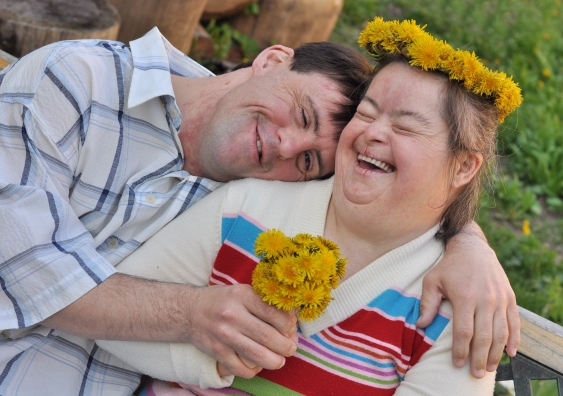
People with intellectual disability are twice as likely to die a preventable death
Tuesday, June 30, 2015
Disabled people pilot a robot remotely with their thoughts
Saturday, May 2, 2015
Advanced material for prosthetic limbs scheduled for launch to Space Station
 Princeton: Lenore Rasmussen's dream of developing a synthetic muscle that could
be used to make better prosthetic limbs and more responsive robots will
literally become airborne at 4:33 p.m. on Monday, April 13, when her
experiment will rocket off to the International Space Station from Cape
Canaveral in Florida. Rasmussen, a synthetic polymer chemist and founder of Ras Labs, has
worked closely with researchers and engineers at the U.S. Department of
Energy's Princeton Plasma Physics Laboratory (PPPL) to
develop the material's ability to adhere to metal. The Synthetic
Muscle™ could be used in robotics in deep space travel such as travel to
Mars because of its radiation resistance. "Based on the good results we had on planet Earth, the next step is
to see how it behaves in a space environment," said Charles Gentile, a
PPPL engineering and scientific staff member who has worked closely with
Rasmussen. "From there the next step might be to use it on a mission to
Mars."
Thursday, April 16, 2015
Children with disabilities can make competent witnesses

Wednesday, April 8, 2015
Australian program helps children with disabilities

Wednesday, March 25, 2015
Video game helps people with prostheses (video)
Groningen: University movement scientists and UMCG rehab specialists are developing an opening and closing exercise using a computer game.
Opening a hand prosthesis can be regulated
precisely. However, it does require good user control. And that takes
practice. A computer game can be useful for that.
Saturday, February 28, 2015
Bionic reconstruction replaces useless hands
Vienna University. Austria: The leading medical journal, "The Lancet", has just published a
study by Oskar Aszmann. In this study, Aszmann describes the bionic
reconstruction technique he has developed at the MedUni Vienna. Complex
neuromuscular procedures are performed to create a biotechnology
interface that gives patients mechatronic hand functions. Patients can
subsequently get on with their lives with two hands again.
People with disabilities experience unrecognized health disparities, new research shows
Oregon University. US: People with disabilities have unmet medical needs and poorer overall
health throughout their lives, and as a result should be recognized as a
health disparity group so more attention can be directed to improving
their quality of life, a team of policy researchers has found.
Wednesday, February 11, 2015
A clearer picture: Predicting disability and death after the ICU
Yale University. US: A growing number of older adults are surviving visits to hospital
intensive care units (ICUs), but many emerge with disabilities such as
impaired walking and poor overall function. A new study by Yale School
of Medicine researchers shows that the level of disability the year
before an ICU visit can predict post-ICU disability and death.
Pitt Team Developing Technology to Allow Amputees to Feel with Prosthetic Limb, Improving Its Function
Pittsburgh University. US: Rehabilitation experts at the University of Pittsburgh School of Medicine
hope to one day give people with an arm amputation a prosthetic limb
that not only moves like a natural one, but “feels” like it, too. They
expect such sensation will improve dexterous control of the device and
give users greater intuition about what they are doing with their
prosthetic.
Equipment library would help ill and the elderly
Canterbury University. New-Zealand: A University of Canterbury student has come up with a novel
library-style scheme to help sustain quality of life for people who are
disabled, ill or need end-of-life care.
Thursday, February 5, 2015
Researchers Determine How the Brain Controls Robotic Grasping Tools
Missouri University. US: Grasping an object involves a complex network of brain functions. First, visual cues are processed in specialized areas of the brain. Then, other areas of the brain use these signals to control the hands to reach for and manipulate the desired object. New findings from researchers at the University of Missouri suggest that the cerebellum, a region of the brain that has changed very little over time, may play a critical role. Findings could lead to advancements in assistive technologies benefiting the disabled.
Monday, January 26, 2015
Artificial limb rehabilitation for older people with a leg amputated at or above the knee because of blood circulation problems
Cochrane: Problems with inadequate circulation in the legs (dysvascularity), particularly in people over the age of 60 years, can be so severe that they need a leg amputated. This may be as high as at or above the knee. Accompanying medical conditions (co-morbidities) such as diabetes, cardiovascular or heart disease can affect a person's rehabilitation. When an above or through knee artificial limb (prosthesis) is fitted, it is hard to regain mobility and function and some people choose to use a wheelchair.
Friday, December 26, 2014
Robots can assist people with disabilities
NIH: Robots interact with patients to help in rehabilitation and movement. New research in robotics might help with stroke rehabilitation, guide wheelchairs, and assist children with Autism Spectrum Disorder.
This is the third year NIH has participated in the Interagency National Robotics Initiative (NRI) to support research to develop innovative co-robots — robots that work cooperatively with people. Other participants are the National Science Foundation, the National Aeronautics and Space Administration, and the U.S. Department of Agriculture. Funding for these projects totals approximately $2.3 million over the next five years, subject to the availability of funds.
“Technology is becoming more and more adaptable in all areas of our life, from GPS in cars to speech recognition technology on smart phones,” said Grace Peng, Ph.D., program director of Rehabilitation Engineering at the National Institute of Biomedical Imaging and Bioengineering (NIBIB). “With these awards, we hope to encourage robotics researchers to think of new ways to apply their technology in the realm of health care.”
About the National Institute of Biomedical Imaging and Bioengineering: NIBIB’s mission is to improve health by leading the development and accelerating the application of biomedical technologies. The Institute is committed to integrating the physical and engineering sciences with the life sciences to advance basic research and medical care. NIBIB supports emerging technology research and development within its internal laboratories and through grants, collaborations, and training. More information is available at the NIBIB website: http://www.nibib.nih.gov.
NINR supports basic and clinical research that develops the knowledge to build the scientific foundation for clinical practice, prevent disease and disability, manage and eliminate symptoms caused by illness, and enhance end-of-life and palliative care. For more information about NINR, visit the website at http://www.ninr.nih.gov.
About the National Institutes of Health (NIH): NIH, the nation's medical research agency, includes 27 Institutes and Centers and is a component of the U.S. Department of Health and Human Services. NIH is the primary federal agency conducting and supporting basic, clinical, and translational medical research, and is investigating the causes, treatments, and cures for both common and rare diseases. For more information about NIH and its programs, visit www.nih.gov.
This is the third year NIH has participated in the Interagency National Robotics Initiative (NRI) to support research to develop innovative co-robots — robots that work cooperatively with people. Other participants are the National Science Foundation, the National Aeronautics and Space Administration, and the U.S. Department of Agriculture. Funding for these projects totals approximately $2.3 million over the next five years, subject to the availability of funds.
“Technology is becoming more and more adaptable in all areas of our life, from GPS in cars to speech recognition technology on smart phones,” said Grace Peng, Ph.D., program director of Rehabilitation Engineering at the National Institute of Biomedical Imaging and Bioengineering (NIBIB). “With these awards, we hope to encourage robotics researchers to think of new ways to apply their technology in the realm of health care.”
- Wearable exoskeletons to induce recovery of function
Recovering limb movement after a stroke can be difficult and frustrating for patients. Research suggests that repeatedly using the affected arm in goal-directed, purposeful movements after a stroke can help promote recovery. This kind of movement is most successful when supervised by therapists. This project hopes to extend therapy into the home by providing patients with a lightweight robotic exoskeleton that can be placed on an affected arm and provide the kind of therapeutic guidance found at a rehabilitation center.
Richard Brent Gillespie, Ph.D., University of Michigan, Ann Arbor
Funded by NIBIB, EB019834 - A computer vision-based active learning co-robot wheelchair
This project hopes to provide a solution for elderly and disabled patients who have limited hand functionality and who rely on wheelchairs for mobility. Researchers hope to create a system and chair that can be controlled by the user’s head movements and will adapt to the individual user. A camera placed on glasses worn by the user can capture head movements designed to control the chair as well as adapt to individual users by gaining information as the patient responds to various situations in natural ways (such as turning their head as their attention shifts). The hope is that the robotic wheelchair will be able to operate almost completely autonomously and only ask for human control on an as-needed basis — learning from the human controls so as to reduce the necessity for human participation in the future.
Gang Hua, Ph.D., Stevens Institute of Technology, Hoboken, New Jersey
Funded by the National Institute of Nursing Research, NR015371 - Music-based interactive robotic orchestration for children with Autism Spectrum Disorder
Many new technologies for children with autism spectrum disorder (ASD) have been developed and demonstrated the possibilities of robotic applications in therapy, but most rely on speech interaction and task-based scenarios. To more effectively stimulate the various emotional and social interactivities of children with ASD, researchers need to take further steps to incorporate multiple types of stimuli. Recent studies have shown improvements in social skills among children with autism who were encouraged to improvise with musical instruments or song. This project aims to develop a music-based system that will help children with ASD interact with a robotic companion in a safe and natural manner. The results of this study have the potential to help develop innovative interventions for ASD.
Chung Hyuk Park, Ph.D., New York Institute of Technology, New York City
Funded by the Eunice Kennedy Shiver National Institute of Child Health and Development, HD082914
About the National Institute of Biomedical Imaging and Bioengineering: NIBIB’s mission is to improve health by leading the development and accelerating the application of biomedical technologies. The Institute is committed to integrating the physical and engineering sciences with the life sciences to advance basic research and medical care. NIBIB supports emerging technology research and development within its internal laboratories and through grants, collaborations, and training. More information is available at the NIBIB website: http://www.nibib.nih.gov.
NINR supports basic and clinical research that develops the knowledge to build the scientific foundation for clinical practice, prevent disease and disability, manage and eliminate symptoms caused by illness, and enhance end-of-life and palliative care. For more information about NINR, visit the website at http://www.ninr.nih.gov.
About the National Institutes of Health (NIH): NIH, the nation's medical research agency, includes 27 Institutes and Centers and is a component of the U.S. Department of Health and Human Services. NIH is the primary federal agency conducting and supporting basic, clinical, and translational medical research, and is investigating the causes, treatments, and cures for both common and rare diseases. For more information about NIH and its programs, visit www.nih.gov.
Subscribe to:
Posts (Atom)